

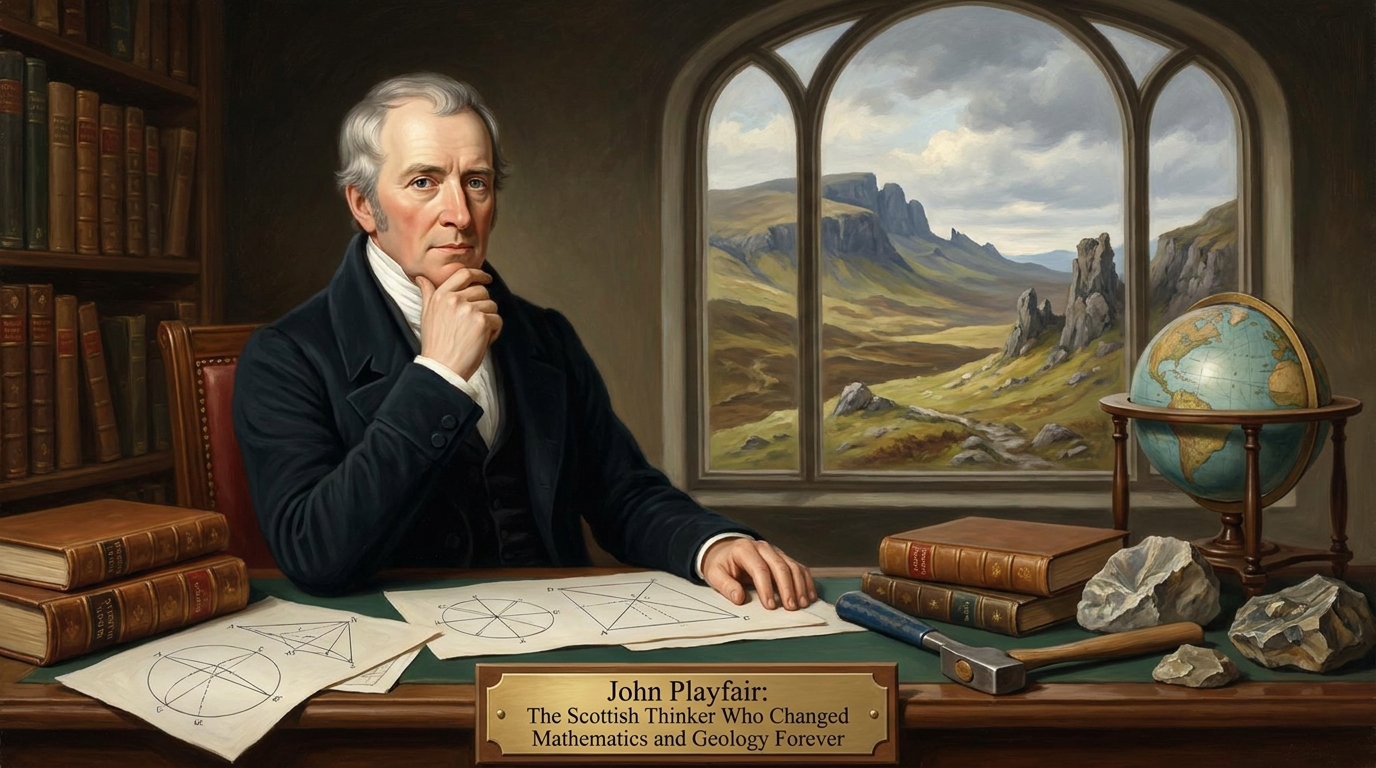
The story of John Playfair is one of intellectual curiosity, scientific courage, and lasting influence. Although he is not always as widely recognized as some of his contemporaries, Playfair played a major role in shaping modern mathematics, astronomy, and geology during the late eighteenth and early nineteenth centuries. His work helped spread revolutionary scientific ideas across Europe and inspired future generations of scholars.
John Playfair was much more than a mathematician. He was a philosopher, educator, scientist, and communicator who had the rare ability to explain complicated concepts in simple and elegant ways. At a time when science was rapidly evolving, he became one of the strongest voices promoting rational thinking and evidence-based discovery.
Today, historians remember him not only for his academic achievements but also for his contributions to geology, especially his support of groundbreaking theories about the age and formation of the Earth. His writings influenced the scientific community far beyond Scotland and helped establish important foundations for modern scientific thought.
Early Life and Education
John Playfair was born on March 10, 1748, in Scotland. He grew up in a highly intellectual environment where education and learning were deeply valued. His father served as a minister, and from an early age, Playfair showed exceptional talent in mathematics and logical reasoning.
As a child, he displayed unusual intelligence and a remarkable memory. These qualities quickly became evident during his studies. He attended the University of St Andrews, where he excelled in mathematics, philosophy, and theology.
Even during his university years, Playfair developed a reputation as a brilliant thinker. Unlike many scholars of his time who specialized in only one field, he cultivated interests across several disciplines. This broad intellectual approach later became one of his greatest strengths.
His early education also reflected the spirit of the Scottish Enlightenment, a period marked by major advances in science, philosophy, literature, and economics. Scotland during this era produced some of history’s most influential thinkers, and Playfair became one of the notable intellectuals connected to this movement.
Career as a Minister and Academic
Initially, John Playfair followed a religious path similar to his father’s. He became a minister in the Church of Scotland, balancing theological responsibilities with his passion for scientific learning. However, his growing interest in mathematics and natural philosophy eventually led him toward an academic career.
He later joined the University of Edinburgh, where he gained recognition as a talented lecturer and scholar. His teaching style was admired for its clarity and organization. Students appreciated how he transformed difficult scientific ideas into understandable lessons.
Playfair eventually became a professor of mathematics and later a professor of natural philosophy. These positions allowed him to contribute significantly to the scientific community of his time.
His lectures attracted many students because he focused not only on technical details but also on the broader meaning and importance of scientific inquiry. He believed that science should help humanity better understand the world and encourage rational thinking.
Contributions to Mathematics
John Playfair is most famous in mathematics for his work related to geometry. One of his best-known achievements involves what later became known as “Playfair’s Axiom.”
The axiom is closely connected to the geometry developed by the ancient Greek mathematician Euclid. Euclid’s geometry relied on several fundamental assumptions, including the famous parallel postulate. Over time, mathematicians found this particular postulate difficult and awkward compared to Euclid’s other assumptions.
Playfair proposed a clearer and more understandable version of the idea:
Through a point not on a given line, only one line can be drawn parallel to the given line.
This reformulation became widely accepted because it simplified the concept without changing its meaning. Today, many geometry students still encounter Playfair’s version when studying Euclidean geometry.
His work helped make mathematical education more accessible. Rather than focusing solely on abstract theory, he emphasized clarity, precision, and effective communication.
The Importance of Playfair’s Geometry Work
The significance of Playfair’s contribution goes far beyond classroom learning. His reformulation of Euclid’s parallel postulate eventually became important in the development of non-Euclidean geometry.
In the nineteenth century, mathematicians began exploring geometries where Playfair’s Axiom did not apply. These discoveries completely transformed mathematics and later influenced physics, especially theories about space and time.
Although Playfair himself worked within traditional Euclidean geometry, his clear presentation of the parallel axiom helped future mathematicians understand exactly what assumptions formed the basis of geometric systems.
This clarity became essential for later scientific revolutions.
John Playfair and the Scottish Enlightenment
The Scottish Enlightenment was one of the most intellectually productive periods in European history. During this era, Scotland produced major thinkers in philosophy, economics, engineering, literature, and science.
Playfair was deeply connected to this intellectual movement. He interacted with scholars who believed that human progress depended on reason, observation, and education.
The Scottish Enlightenment encouraged open discussion and scientific experimentation. Rather than accepting old beliefs without question, thinkers of the time examined evidence carefully and sought logical explanations for natural phenomena.
Playfair embodied these values perfectly. His writings consistently promoted rational inquiry and scientific understanding.
He also contributed to scholarly societies and participated in discussions involving mathematics, astronomy, geology, and philosophy. His broad range of interests reflected the Enlightenment ideal of the well-rounded intellectual.
Contributions to Geology
Although John Playfair achieved fame as a mathematician, his impact on geology may be even more historically important.
He became one of the strongest supporters of the geological theories proposed by James Hutton, often called the “father of modern geology.”
Hutton introduced revolutionary ideas about the Earth’s formation. At the time, many people believed the Earth was only a few thousand years old. Hutton challenged this belief by arguing that geological processes occurred gradually over immense periods of time.
These ideas were controversial because they contradicted traditional interpretations of history and religion.
Playfair recognized the brilliance of Hutton’s work and helped explain it to a wider audience.
Explaining Hutton’s Revolutionary Theory
One of Playfair’s greatest talents was communication. James Hutton’s original writings were often difficult to understand because they were dense and highly technical.
Playfair took Hutton’s complex ideas and presented them in a more organized and readable form. In 1802, he published Illustrations of the Huttonian Theory of the Earth, a book that helped popularize Hutton’s geological theories.
This publication explained concepts such as erosion, sedimentation, volcanic activity, and the gradual shaping of landscapes over enormous timescales.
Playfair argued that natural forces operating slowly over long periods could explain mountains, valleys, rocks, and other geological formations.
This idea later became known as uniformitarianism — the principle that the same natural processes observed today operated in the past.
Uniformitarianism became one of the foundations of modern geology.
Siccar Point and Geological Discovery
One of the most famous moments connected to Playfair involved a visit to Siccar Point with James Hutton and other scientists.
At Siccar Point, they observed dramatic rock formations showing layers of stone tilted at different angles. This geological feature provided visible evidence that the Earth had undergone multiple cycles of change over immense spans of time.
Playfair later described the experience with great enthusiasm. He realized that the rocks represented a history far older than previously imagined.
The observation strongly supported Hutton’s theories and became one of geology’s most iconic discoveries.
Today, Siccar Point remains an important location in the history of Earth science.
Role in Astronomy and Natural Philosophy
Playfair also contributed to astronomy and natural philosophy, fields closely connected to mathematics during his time.
He studied planetary motion, gravity, and celestial mechanics. His mathematical skills enabled him to understand and explain complicated astronomical principles.
Like many Enlightenment scientists, he viewed the universe as a system governed by discoverable natural laws. He believed careful observation and mathematical reasoning could reveal the structure of reality.
His lectures in natural philosophy covered topics ranging from mechanics to optics and astronomy. Students admired his ability to combine technical expertise with philosophical insight.
Writing Style and Intellectual Influence
One reason John Playfair became influential was his exceptional writing style.
Many scientists of his era wrote in overly technical or confusing ways. Playfair, however, emphasized elegance and clarity. He believed scientific ideas should be understandable to educated readers beyond narrow academic circles.
His essays and books were praised for their precision and readability. This skill helped spread new scientific concepts more effectively.
Playfair also wrote biographical essays about fellow scientists and intellectuals. These writings preserved valuable historical information about the scientific community of the Scottish Enlightenment.
His work demonstrated that communication is just as important as discovery in advancing human knowledge.
Relationship with Other Scientists
Playfair lived during a remarkable scientific period and interacted with many important thinkers.
He respected James Hutton deeply and became one of his closest intellectual allies. He also maintained connections with leading mathematicians, philosophers, and scientists throughout Britain and Europe.
The scientific world of the eighteenth century relied heavily on correspondence, lectures, and scholarly societies. Playfair actively participated in these networks, exchanging ideas with other intellectuals.
His reputation for intelligence and fairness earned him widespread respect.
Unlike some scholars who sought personal fame, Playfair often focused on supporting and explaining the ideas of others. This collaborative spirit strengthened the scientific community around him.
Educational Legacy
John Playfair left a lasting mark on education.
His textbooks and lectures influenced mathematical instruction for many years. Students appreciated his organized teaching methods and clear explanations.
He believed education should encourage critical thinking rather than simple memorization. This philosophy aligned with Enlightenment values emphasizing reason and independent inquiry.
Playfair’s approach helped modernize scientific education in Scotland and beyond.
His version of Euclid’s parallel postulate continued appearing in geometry textbooks for generations. Even today, his name remains familiar to students studying classical geometry.
Influence on Future Geologists
Playfair’s support of Huttonian geology helped pave the way for future scientific breakthroughs.
Later geologists, including Charles Lyell, built upon the principles Playfair helped popularize. Lyell’s work strongly influenced Charles Darwin during the development of evolutionary theory.
Without the concept of deep geological time, Darwin’s theory of evolution would have been much harder to explain. Evolution by natural selection requires enormous timescales for gradual biological change.
In this indirect but important way, Playfair contributed to one of the greatest scientific revolutions in history.
His efforts to explain geology clearly helped create a broader understanding of Earth’s ancient history.
Personal Characteristics
Historical accounts describe John Playfair as calm, thoughtful, and intellectually generous.
He was known for his modest personality and polite manner. Unlike some controversial scientific figures, he rarely sought confrontation.
Instead, he focused on careful reasoning and respectful discussion. His balanced temperament made him an effective communicator and teacher.
Friends and colleagues admired his integrity and dedication to learning.
Even when defending revolutionary scientific ideas, he presented arguments logically and patiently rather than aggressively.
Death and Lasting Recognition
John Playfair died in 1819, leaving behind an extraordinary intellectual legacy.
Although he may not always receive the same public recognition as some famous scientists, historians understand the importance of his contributions.
His work in mathematics clarified essential geometric principles. His support for geology helped transform humanity’s understanding of Earth’s history. His educational efforts improved scientific communication and teaching.
Today, his name survives through mathematical terminology, historical scholarship, and the continuing influence of the ideas he promoted.
Universities and historians still study his writings as valuable examples of Enlightenment science and intellectual culture.
Why John Playfair Still Matters Today
Modern science depends heavily on clear thinking, evidence-based reasoning, and effective communication. John Playfair exemplified all three qualities.
In many ways, he represents the ideal scientist-scholar:
- Curious across multiple disciplines
- Committed to education
- Skilled at explaining difficult ideas
- Open to revolutionary evidence
- Respectful in intellectual debate
His life also reminds us that scientific progress often depends not only on original discoveries but also on those who explain and defend important ideas.
Without communicators like Playfair, groundbreaking theories may never reach wider audiences.
In the modern world, where scientific literacy remains essential, his example continues to inspire educators, researchers, and students alike.
Conclusion
John Playfair was one of the most influential intellectual figures of the Scottish Enlightenment. Through his work in mathematics, geology, astronomy, and education, he helped shape modern scientific understanding.
His reformulation of Euclid’s geometry simplified mathematical learning and contributed to future developments in geometric theory. His support of James Hutton’s geological ideas transformed how humanity understood the Earth’s age and natural processes.
Beyond his discoveries and writings, Playfair’s greatest strength may have been his ability to communicate knowledge clearly and thoughtfully. He believed science should be accessible, rational, and grounded in observation.
More than two centuries after his death, his influence remains visible in classrooms, scientific disciplines, and the history of modern thought. John Playfair’s legacy continues to demonstrate the enduring power of curiosity, education, and intellectual courage.